
Remote sensing activities to support the Sustainable Development Goals
The Sustainable Development Goals (SDGs) are 17 goals set by world leaders to be achieved by 2030, responding to the world's main development challenges. Such Goals are complemented by many targets and are to be measured by a large set of indicators. Remote sensing, with its capability to monitor several parameters systematically at a global scale, can surely provide valuable support to the SDGs. In CTTC, we have a strong experience in remote sensing, which can be relevant to different SDGs. Such an experience is mainly based on active radar remote sensing using Synthetic Aperture Radar (SAR) and the interferometric SAR (inSAR) technique. In particular, we focus on six types of remote sensing applications: urban deformation monitoring, landslide and subsidence monitoring, deformation monitoring related to mining activity and mining security, glacier velocity monitoring, environmental monitoring, and coastal monitoring.
Urban deformation monitoring by InSAR
InSAR is a powerful remote sensing technique to monitor land deformation. The technique works particularly well over urban areas and infrastructures. This is because man-made objects (buildings, structures and infrastructures) are optimal targets for InSAR. A typical application is the monitoring of subsidence phenomena. Another important application is the monitoring of the deformations associated to construction works, especially those that involve changes in the water table. The urban deformation monitoring by InSAR can contribute to SDG11, “Sustainable cities and communities”.
Landslide and subsidence monitoring by InSAR
InSAR is widely used to monitor landslides and subsidence areas. In recent years, InSAR and PSI have improved their performance, particularly in terms of the capability to cover wide areas. We intend to cover wide areas, the monitoring of entire regions or even nations. This is possible due to the availability of systematic SAR acquisitions over large areas, the readiness of mature InSAR processing tools, and the access to powerful computational resources. There are several examples of InSAR-based subsidence monitoring. Landslide and subsidence monitoring by InSAR can contribute to SDG13, “Climate Action”, and SDG11, “Sustainable cities and communities”.
Deformation monitoring related to mining activity and mining security by InSAR
A sector where InSAR products are used at the operational level is mining. Several companies worldwide provide InSAR deformation monitoring for mining companies. The monitoring can regard underground mining (looking at the impact on the surface), open pit mines (monitoring the stability of the open pit slopes and the surrounding areas), mine installations, and abandoned mines. Deformation monitoring related to mining activity can contribute to SDG7, “Energy Access and Sustainability”, SDG9, “Infrastructure, Innovation and Industrialization”, and SDG15, “Life on Land”.
Glacier velocity monitoring by InSAR and Pixel Tracking
Glaciers play a critical role in climate monitoring. Observing their dynamics is key for studying their response to a changing climate and predicting their evolution. An important glacier monitoring product is glacier velocity. In fact, climate change is not only driving glacier retreat, but also, in some areas, driving large-scale changes in glacier ice-flow dynamics and velocity. Measuring glacier velocity is therefore essential for understanding the impact of climate change on ice dynamics. Glacier velocity monitoring by InSAR and Pixel Tracking can contribute to SDG13, “Climate Action”.
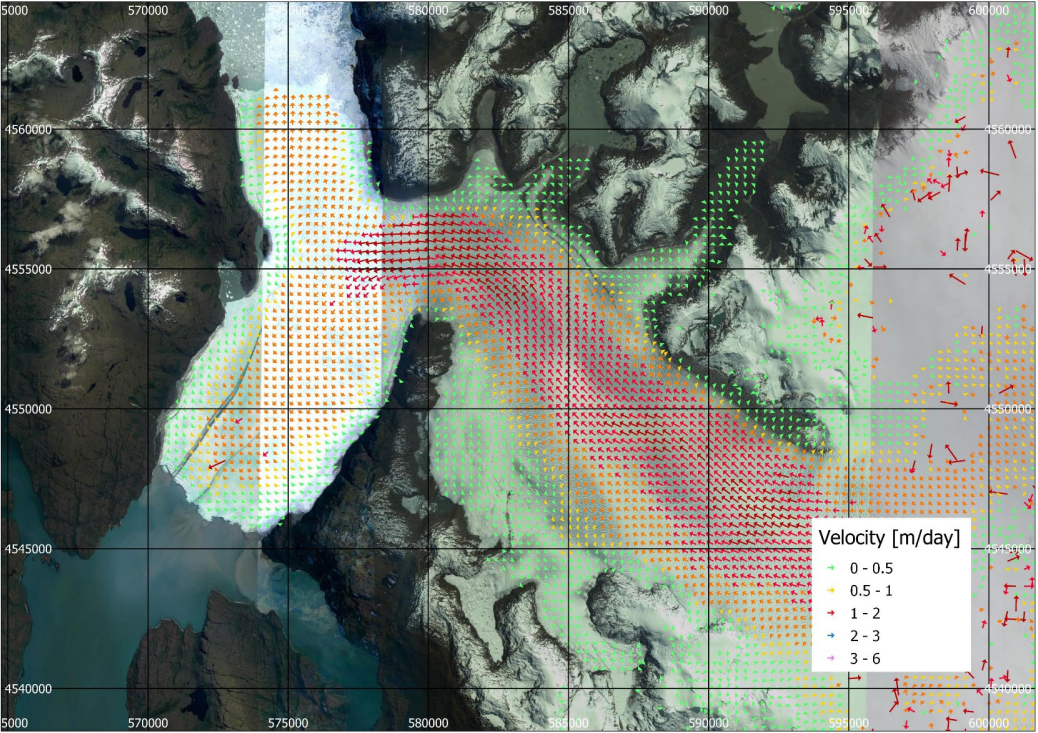 Glacier velocity estimated using Pixel Offset Tracking. Example over Campos de Hielo Sud (Chile)
Environmental monitoring using SAR, optical and multi-spectral remote sensing
Environmental monitoring can largely benefit from the continuous observation capabilities of current remote sensing satellites. There are countless applications of this type of monitoring, which can offer medium to high spatial resolution, relatively high temporal resolution, and wide-area coverage at relatively low cost. The most important source for environmental monitoring is optical remote sensing, which exploits multi-spectral bands in the visible range of the electromagnetic spectrum and bands close to visible. In several applications, additional useful information can be derived by fusing multispectral and SAR data. The latter data can include the SAR amplitude imagery and other interferometric products, like the coherence images. Environmental monitoring based on SAR, optical, and multispectral remote sensing can provide a fundamental contribution to SDG13, “Climate Action”.
Another example of vegetation monitoring is in an arid ecosystem. This type of application is crucial for achieving the SDG15, “Life on Land”. Monitoring plant health helps mitigate climate change because vegetation acts as a carbon sink. Monitoring vegetation is also essential for conserving biodiversity and the ecosystem services that sustain local life.
Coastal monitoring using InSAR and optical remote sensing
Another important remote sensing application is coastal monitoring. Like in environmental monitoring, coastal monitoring can be based on optical, multi-spectral and radar data. The use of remote sensing can help in managing coastal territory, which often consists of extensively modified natural spaces, under strong urban development pressure, where terrestrial and marine processes interact, and that are often vulnerable to the effects of climate change. The continuous monitoring based on remote sensing data and analysis tools can substantially contribute to SDG11, “Sustainable cities and communities”, SDG13, “Climate Action”, and SDG15, “Life on Land”.
Acknowledgements
This work has been partially fund by the the European Union’s Horizon Europe Research and Innovation Programme through the Doctoral Network of the Marie Sklodowska-Curie Actions SMILE, under grant agreement No. 101073281.