
Biomass estimation in mangrove forest - Lacuna Colombia project
Mangrove ecosystems provide critical ecological and economic services, particularly their capacity to sequester and store large amounts of carbon, making them vital “blue carbon” ecosystems. However, they are threatened by climate change and human activities, which can release significant amounts of stored carbon. Accurate quantification of carbon stocks is essential to assess the roles of mangrove forests in climate change mitigation, guide conservation priorities, and inform policies that link carbon storage with biodiversity protection and sustainable development. Reliable data also supports financial mechanisms such as carbon offset projects, payments for ecosystem services, and initiatives like REDD+.
Estimating Above-Ground Biomass (AGB) is key to quantifying mangrove carbon stocks, but direct measurement methods are costly, labor-intensive, and limited in spatial coverage. Allometric equations derived from field measurements offer indirect estimates but still face challenges in large and inaccessible mangrove areas. Remote sensing provides a scalable alternative, enabling cost-effective AGB and Above-Ground Carbon (AGC) estimation. Technologies such as UAV imagery, multispectral and hyperspectral sensors, microwave data, and LiDAR have been applied, often in combination, to improve accuracy. While airborne LiDAR is precise, its high-cost limits widespread use, making satellite-based methods combined with machine learning approaches increasingly valuable for large-scale monitoring.
This study demonstrates that it is both feasible and reasonably accurate to estimate AGB in mangrove ecosystems by combining open-access satellite-derived variables with field-based measurements. The integration of multiple data sources, including Sentinel-2 spectral indices, Sentinel-1 radar backscatter, and derived texture features, enhanced the robustness and explanatory power of the predictive models.
Field data proved to be indispensable for both model calibration and validation. Despite the limited number of in-situ observations (20 plots within VIPIS and 32 additional plots from other Colombian mangrove areas), these measurements provided a foundation for training the models and allowed comparisons with existing global biomass products.
However, increasing the number and spatial representativeness of field samples is essential to improve model reliability. A larger, well-distributed field database would enable the model to capture more consistent relationships between remote sensing variables and biomass, thereby reducing uncertainty and producing estimates more closely aligned with real conditions.
Ultimately, this work contributes to the ongoing effort to improve free and open-access data availability for mangrove ecosystems and encourages future projects aimed at integrating field measurements, satellite observations, and advanced machine learning methods. Such combined approaches are key to progressively achieving more precise, scalable, and operational biomass estimations in complex coastal environments.
Lacuna Colombia project has been developed within Geomatics Reserach Unit by María Cuevas-González, Qi Gao, Eduard Angelats and Michele Crosetto.
More info about the project in its webpage.
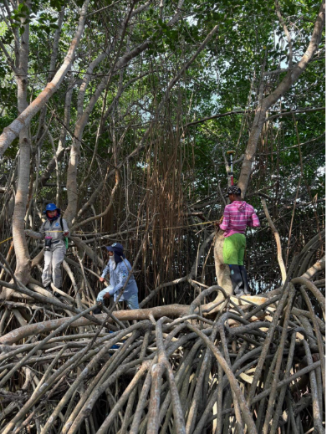 Researches conducting field data collection in a mangrove sample plot in the western sector of the Vía Parque Isla de Salamanca (Colombia).
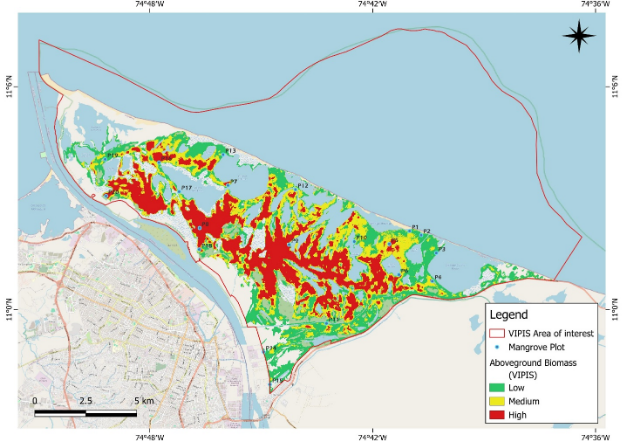 Spatial distribution of mangrove sample plots in the western sector of the Vía Parque Isla de Salamanca (Colombia), displayed over the predicted AboveGround Biomass (AGB) layer generated using a Random Forest model.